Meats and Sausages

Sauerkraut
Sauerkraut is the German word for fermented, salted, shredded cabbage. In Poland it is known as kapusta kiszona, in Ukraine it is called kysla kapusta and in Russian kyslya kapusta. The sauerkraut manufacturing process is very simple and requires only salt, cabbage and time. The fermenting temperature will affect the quality of the product. In addition to salt other ingredients are sometimes added, for example apples, juniper berries or caraway seeds. In Asian countries such as China, Japan and Korea making fermented cabbage products is an art in itself. There, fermented cabbage is mixed with other vegetables, as well as with pickled shrimp and oysters.
Hot peppers are always added, a procedure that is usually not practiced in Europe. Sauerkraut was the most important vegetable in the Roman Empire and was thought to have medicinal values. Originally it was made by soaking cabbage leaves in vinegar or sour wine. In medieval times in Germany and Poland cabbage was fermented with salt, seasonings and berries. Sauerkraut made with quartered apples or sliced apples turns out particularly nice. Regardless of how it is made or called, all fermented cabbages share one factor together: they are very healthy. Sauerkraut is rich in vitamin C, an important fact that was known in the past. Barrels of sauerkraut were kept on ships to provide a supply of vitamin C and to prevent a nasty disease known as scurvy. Scurvy infected gums which resulted in a loss of teeth and eventual death. Between 1500 and 1800, it has been estimated that scurvy killed at least two million sailors. According to Jonathan Lamb, "In 1499, Vasco da Gama lost 116 of his crew of 170; In 1520, Magellan lost 208 out of 230; all mainly to scurvy." It has been recorded that when Captain Cook secured barrels with sauerkraut for his voyages, he did not lose one sailor to the disease. However, it was not until 1747 that James Lind formally proved that scurvy could be treated and prevented by supplementing the diet with citrus fruit such as limes or lemons.

In older times in Europe young children were walking barefoot on sauerkraut in huge oak barrels and that helped to release more juice. This should not come as a surprise because wine was made the same way. In large wooden casks, the children and young ladies were dancing on wine grapes in order to release juice from the grapes.
Fermented sauerkraut is considered a probiotic, a natural ingredient that is beneficial to one's health. Probiotics contain live microorganisms thought to be healthy for the host organism. Lactic acid bacteria are present in our intestines and are responsible for digesting food. They break down food by fermentation. Homemade sauerkraut is loaded with lactic acid bacteria, so is yogurt, which is another probiotic. A fermented cabbage contains living bacteria from the Lactobacillus family, the same bacteria are present in our digestive tract. Whenever we ingest sauerkraut we supply an additional army of bacteria which lends a helping hand to bacteria which are already present in our stomach.
Now our body gets a little break and can work less hard. Take for example a person that was very sick and accepted a heavy dose of antibiotics, or a person that has been under chemotherapy treatment. Those treatments kill all kinds of bacteria in our body, both the bad and the good ones. In such a case eating sauerkraut will speed up the rebuilding of the bacterial flora that was damaged by the medical treatments. In many German households a child had to eat sauerkraut on a weekly basis as it "was good for him."
A very important distinction must be made here, between a naturally fermented cabbage made at home and its commercially produced version. Only fermented and uncooked sauerkraut exhibits those beneficial characteristics. Cans of commercially manufactured sauerkraut are usually pasteurized (heat treated) in order to increase storage life. This process kills Lactobacillus beneficial bacteria and destroys some of the vitamin C, therefore such a product does not offer the same health benefits as homemade sauerkraut. The product becomes a sauerkraut flavored cabbage, but cannot be considered the probiotic anymore. What is left is just a can of fermented cabbage. Much of the commercial sauerkraut cabbage is not even fermented but only soaked in salt and vinegar to mimic the flavor of traditional sauerkraut.
Cabbage in all of its forms was and still is very popular in Europe and we find cabbage soup, stuffed cabbage with meat and rice or sauerkraut with meat and potatoes. It tastes great when served with a grilled sausage and you can find street carts that serve hotdogs with sauerkraut in the USA as well. It was the most important vegetable in the Roman Empire and was thought to have medicinal values. Originally it was made by soaking cabbage leaves in vinegar or sour wine. In medieval times in Germany and Poland cabbage was fermented with salt, seasonings and berries. Sauerkraut made with quartered apples or sliced apples turns out particularly nice. Today most sauerkraut is made with salt only and the manufacturing process is very simple.
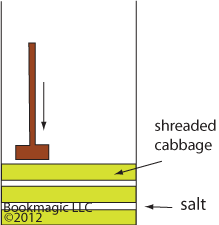
Shredded cabbage is either packed in layers and sprinkled with salt or it is mixed with salt in a mixing bowl. The cabbage is packed with a pusher tool, hands or potato masher.
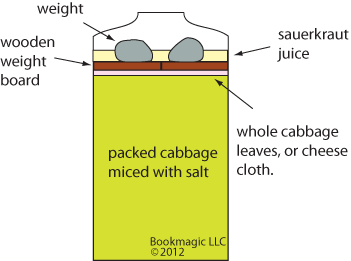
Shredded cabbage is covered with whole cabbage leaves or cloth and is weighted. The cabbage releases juice and it should be soon submerged in its own brine. The cabbage starts to ferment.
Note The process of making sauerkraut and pickled cucumbers is very similar. Both products are made with the same equipment. To fully grasp the subject it is advisable to read both sections.